Warning: Cannot modify header information - headers already sent in /home/u278635817/domains/mymorninglife.com/public_html/wp-content/plugins/artigosgpt/artigosgpt.php on line 29509
Warning: Cannot modify header information - headers already sent in /home/u278635817/domains/mymorninglife.com/public_html/wp-content/plugins/artigosgpt/artigosgpt.php on line 29509
The light in New York changes like a mood swing — sudden, dramatic, unforgettable. Walk into DUMBO or stand on the High Line at the right minute and the whole city can flick from gray to gold. If you care about color, texture and a shot that stops a scroll, understanding where and why that happens is everything. This guide, focused on Sunset in NYC, picks 11 neighborhoods where golden hour behaves like a show and gives you quick composition and gear tips to actually capture it.
Why DUMBO’s Brick and Steel Turn to Liquid Gold
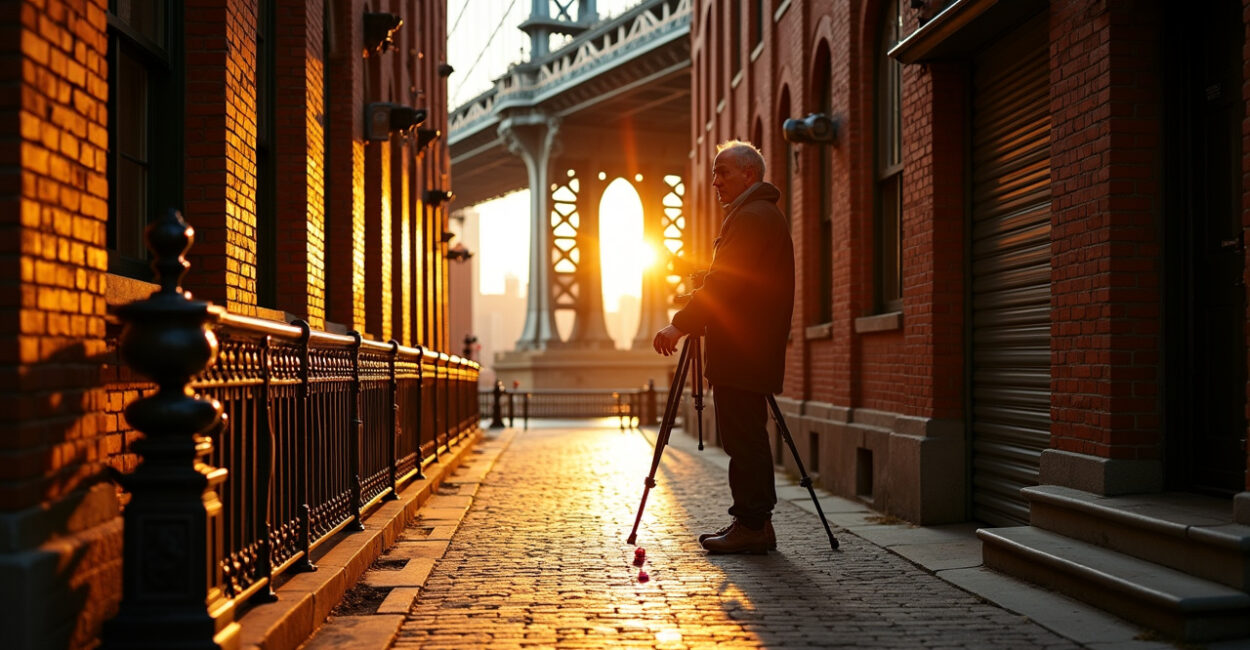
DUMBO is pure alchemy at sunset. The sun sinks behind Manhattan, slanting across cobblestones and red brick, which soak up warm tones and reflect them into the river. The contrast between old masonry and modern glass creates depth you can read in a single frame.
Composition tip: use the Manhattan Bridge as a framing device and shoot wide to keep foreground texture. Gear tip: a 24–70mm for flexibility; a polarizer to manage glare off the river. Try underexposing by a third stop to preserve highlights.
Why Williamsburg Gives a Cinematic Glow Almost No Lens Resists
Williamsburg’s warehouses and rooftop gardens catch sunset like a filter. Low sun, lots of glass and painted walls give you colorful reflections and long, dramatic shadows. This neighborhood favors side-light that sculpts faces and façades alike.
Try shooting from rooftops for skyline silhouettes or along Bedford Avenue for layered depth. Use a 50mm for portraits and an ultra-wide for street-to-sky panoramas. Avoid heavy HDR — it kills the soft warmth you came for.
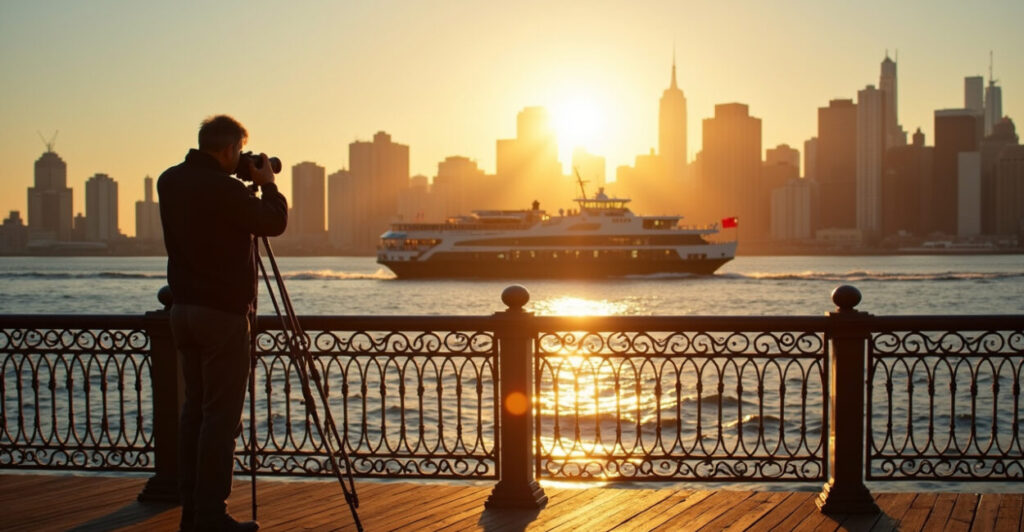
How Brooklyn Heights Promenade Turns Skyline Reflections Into Foreground Interest
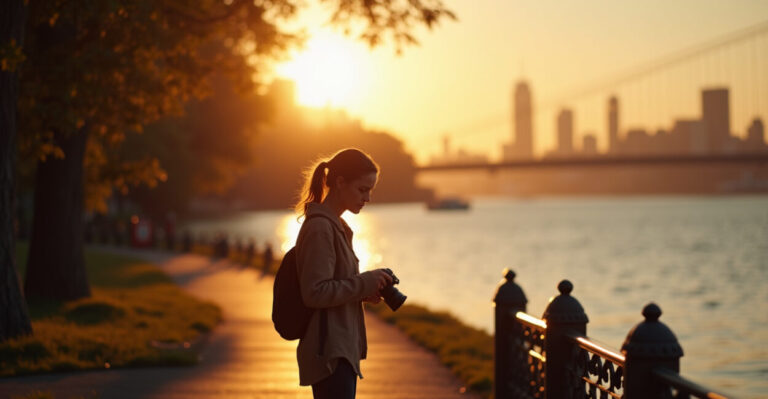
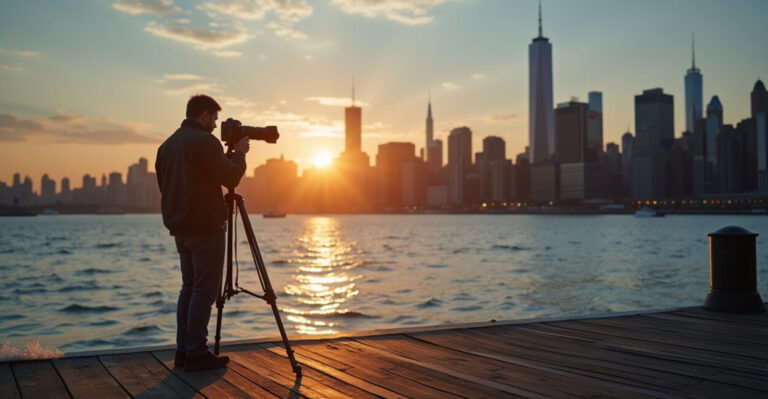
The Promenade is a textbook case of foreground meeting skyline. Golden hour lights the East River, then throws it back at you. Reflections, ripples and passing ferries add motion to otherwise static skyline shots.
- Place the skyline on the upper third and include ripples in the lower third.
- Use a small aperture (f/8–11) for sharp depth and a faster shutter to freeze ferries.
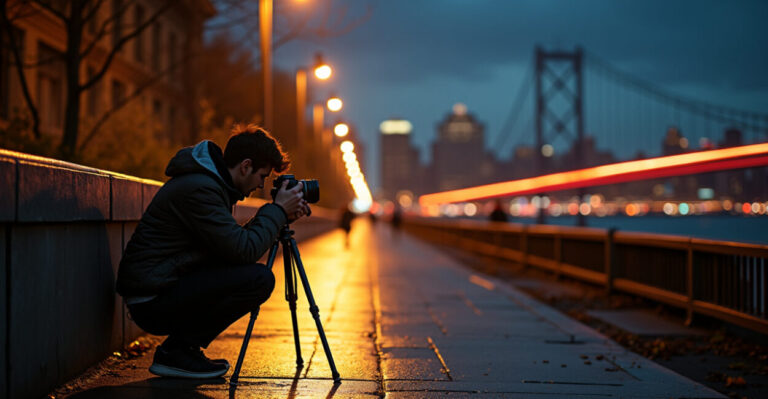
Gear: tripod for long exposures; neutral density only if you want glass-smooth water for a painterly feel.
Sunset in NYC: Why the Financial District Turns Glass Towers Into Molten Mirrors
The Financial District is a lesson in reflected light and geometry. Narrow streets and tall towers mean light bounces and pools in unexpected places. At golden hour, glass façades become gigantic mirrors showing parts of the city that aren’t even in your frame.
Composition tip: hunt for alleyways where the sun slices through. Gear tip: bring a wide-angle and a tele for compressed, dramatic tower stacks. What to avoid: shooting into the sun without a plan — flare can be creative but often ruins detail.
Hudson Yards to Chelsea: The West Side That Eats the Sunset
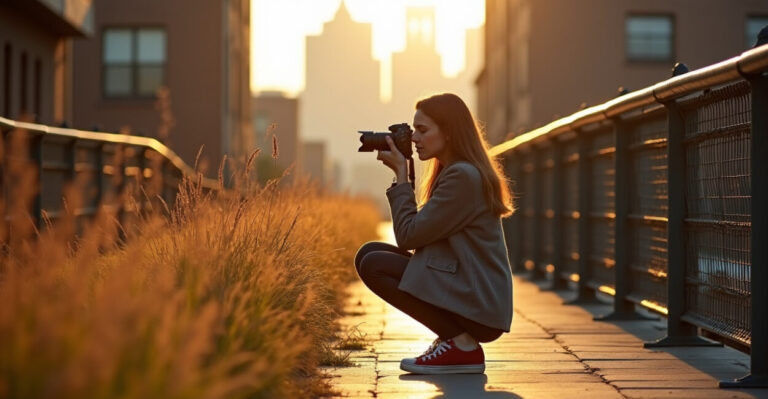
From the High Line to the Vessel, the west side is all about layered light. The setting sun hits the river side of buildings first, then rolls east, lighting façades from the top down. That creates gradients of color that look stunning in panoramas.
Use a stitched panorama or a 35mm prime for a natural look. A graduated ND can balance sky and foreground. If you want people in the frame, shoot earlier in golden hour — later the light favors architecture and loses warmth on faces.
Gantry Plaza, Long Island City: Industrial Lines + River Glow = Magic
LIC’s Gantry Plaza is engineered for sunset drama. The gantries and piers slice the skyline into layers. The sun sets behind Manhattan and paints each layer differently, giving you depth and color contrast in one shot.
Composition tip: include a pier or gantry in the foreground to lead the eye. Gear tip: telephoto lenses compress the Manhattan skyline for a denser, cinematic look. Avoid the “everything-centered” composition — asymmetry feels stronger here.
Fort Tryon and Inwood: Unexpected Alpine Light at the Edge of the City
Up north, green parks and cliffs turn sunset into texture play. Fort Tryon and Inwood are where trees, Hudson vistas and stone walls meet low sun angles. The light filters differently through foliage and softens quicker, giving you tonal variety often missing downtown.
Shoot through branches for a natural vignette and favor golden-hour portraits with a 85mm. Bring a reflector to bounce warm light into shaded faces. Common mistake: shooting too late — the light collapses fast here because hills eat the sun.
Comparison that matters: DUMBO vs. Gantry — DUMBO offers gritty, warm brick tones and wide river reflections; Gantry gives you structured, industrial lines and a compressed skyline. Both are golden, but the mood changes completely. Mini-story: I once waited 40 minutes under a Williamsburg rooftop sign as clouds threatened the light. When the sun punched through, a single ten-second burst of orange washed the whole block. That one shot paid for the coffee I’d been nursing.
Common errors to avoid:
- Chasing exact “golden minute” timing without scouting — half your success is position.
- Over-processing — oversaturated warmth kills nuance.
- Skipping a tripod at low shutter speeds — motion blur sneaks in.
Quick logistics and safety notes: sunset times shift fast near tall buildings. Check local sunset times and plan an extra 20 minutes. For permits or park rules, consult official pages like NYC.gov or park guidelines at NYC Parks. For seasonal light angle data and solar charts, university resources such as Columbia University solar tools can help plan exact aiming.
Final Nudge: Make the Light Your Subject, Not Just the Backdrop
Sunset in NYC is not just pretty — it’s an active ingredient. Treat the light like your subject by watching how it moves, where it warms, and what it hides. Go for one decisive composition, then shoot variations. Your best shot usually comes from restraint, not excess.
Leave the tripod in the car for one set, then use it for long exposures on the next. That contrast in approach will teach you more about the city’s light than any tutorial.
When is the Best Time to Shoot Sunset in NYC During the Year?
The best time depends on what you want. Late spring and early fall offer longer golden hours with warm, clear light and comfortable temperatures. Winter gives crisp, low-angle light but shorter windows — often less than 20 minutes of ideal color. Summer sunsets are longer but can be hazy and less colorful. Plan to arrive at least 30–45 minutes before sunset for scouting, then stay 20 minutes after; the real color often happens in that brief tail after the sun dips below the skyline.
What Camera Settings Work Reliably for Golden Hour Landscape Photos?
Start with ISO 100–200 for clean files. Aperture depends on depth: f/8–11 for landscapes to get edge-to-edge sharpness; f/2.8–4 for portraits to separate subjects from background. Shutter speed varies — use a tripod for anything under 1/60s. Expose for highlights: drop exposure a third to a full stop to preserve warm sky detail and recover shadows in post if needed. Shoot RAW to keep latitude for white balance and tone adjustments later.
Which Lenses Are Must-haves When Photographing NYC Sunsets?
An everyday kit: a wide (16–35mm) for sweeping cityscapes, a standard zoom (24–70mm) for versatile framing, and a short tele (70–200mm) to compress skylines and pick out architectural details. Bring a 50mm or 85mm prime if you plan portraits. If you only carry one lens, a 24–70mm covers most golden-hour needs. Don’t forget a circular polarizer to cut reflections and a small microfiber cloth — glass and water spots are common near piers and promenades.
How Do I Handle Crowds and Pedestrians During Golden Hour Shoots?
Arrive early and stake a small claim to a viewpoint. Use a longer lens to isolate subjects if crowds are unavoidable. For empty-looking scenes, shoot earlier in the hour or later in the blue hour when crowds thin. Patience is a tool: wait for a gap of a few seconds and you’ll often get a cleaner frame. If you need people in the shot, embrace them — silhouettes or candid interactions can add scale and story that empty skylines rarely convey.
Can Phone Cameras Capture the Same Golden Light as DSLRs in NYC?
Yes — modern phones are excellent for golden hour, especially with manual exposure control and RAW capture. Phones handle dynamic range differently, so guard against auto-HDR that flattens color. Use portrait mode for depth, and try lens-multipliers or clip-on wide adapters for varied perspectives. Stabilize the phone for low-light shots or use a small tripod. The main limitation is sensor size; subtle shadow detail and low-light performance still favor larger sensors for final prints or heavy crops.