

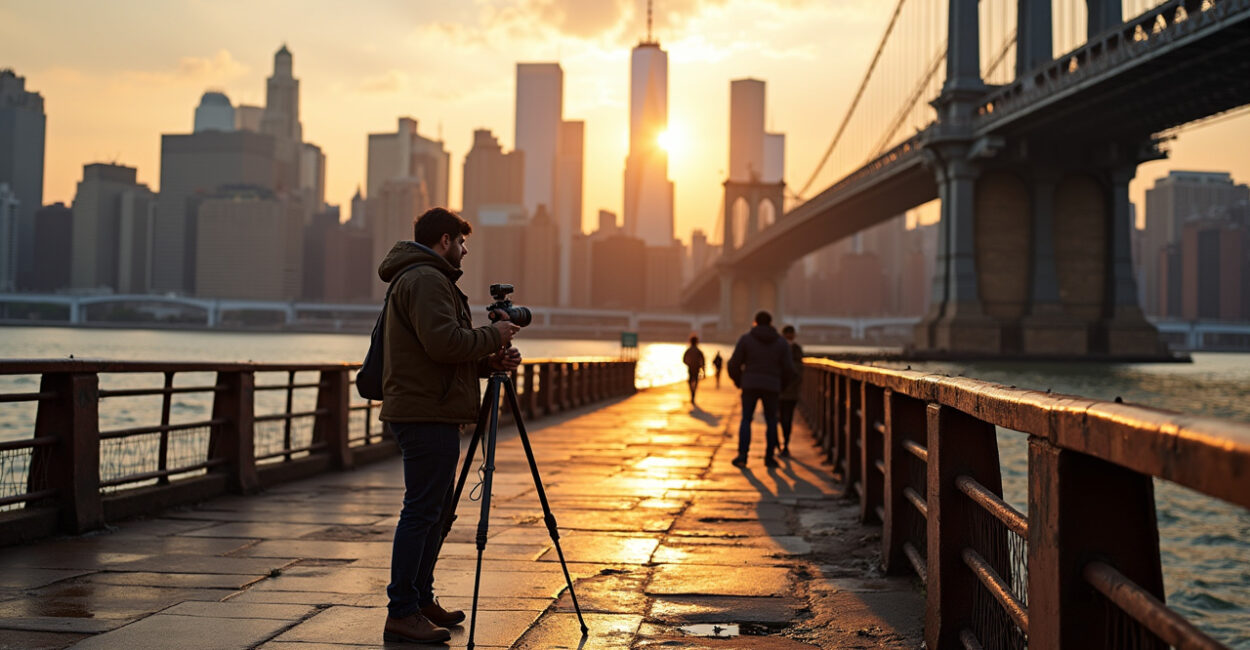
I was standing on a wind-whipped pier as the sun hit One World Trade like a coin — the kind of color that stops your scroll. If you want that hit of Manhattan framed by water, steel, and old Brooklyn brick, this guide maps the exact piers and rooftops to get it. It also tells you which lens to pack, when to arrive to avoid the crowd, and the low-light hacks that actually work. Let’s get you the shot that makes people tap, save, and ask, “Where is that?”
Why DUMBO Pier Still Outsmarts Every Other View
DUMBO’s waterfront gives you the classic Manhattan sweep — no contest. The triangle of Washington Street, Main Street Park, and the waterfront lets you frame the Brooklyn Bridge with lower Manhattan behind it. Early evening here gives long shadows and a warm glow on the bridge cables.
- Best time: 45–15 minutes before sunset for golden-hour light.
- Lens: 24–70mm for flexibility; 50mm for tighter bridge portraits.
- Tip: Use the cobblestone alleys for foreground texture.
Where to Stand at Brooklyn Bridge Park for Wide, Cinematic Skies
Brooklyn Bridge Park isn’t one place — it’s a sequence of frames. Pebble Beach (Pier 1) gives foreground rocks and reflections. Pier 3 lines you up for a low, layered skyline. If you want symmetry, walk the step plazas at Pier 4.
- Arrive early: crowds spike 30 minutes before sunset.
- Low-light tip: set ISO between 200–400 with a tripod; shoot multiple exposures for HDR.

The Rooftops That Hide in Plain Sight (And How to Access Them)
Not all rooftop views need a penthouse pass. Bars and community gardens on Williamsburg and Brooklyn Heights offer cropped Manhattan vistas. Seek rooftops with a clear south-west line of sight—those will catch the towers as the sun dips.
- Access: many bars allow patrons; book a table if you need to bring gear.
- Etiquette: keep gear compact and avoid blocking walkways.
- Best lenses: 35mm for environmental portraits, 85mm for tight building studies.
The Night Game: Low-Light Techniques That Don’t Look Like Phone Pics
Low-light is where cheap technique shows — don’t be that person. Use a fast prime (35mm f/1.8 or 50mm f/1.4) for handheld shots. When you can, stabilize: a small travel tripod plus a 2–3 second shutter removes handshake and gives clean lights.
- Settings starter: aperture f/2.8–f/4, ISO 400–800, shutter 1/10–1/60 if handheld.
- When lights blur intentionally: use a 1–2 second exposure and move slightly for light streaks.
- Always shoot RAW for recoverable highlights and shadow pull.
Lens Choices: One Bag for All Brooklyn Skyline Moments
One good kit covers 90% of skyline work. I travel with a wide zoom, a standard zoom, and one fast prime. That gives you everything from expansive river panoramas to intimate skyscraper details.
- Wide: 16–35mm — for piers and tight bridge foregrounds.
- Standard: 24–70mm — your daily workhorse for most shots.
- Prime: 35mm or 50mm f/1.8 — low-light and portraits.
Comparison: A phone crop vs. a 35mm f/1.8 on a full-frame camera — the phone flattens the scene; the prime gives depth, cleaner highlights, and usable low-light detail.
The Timing Trick: Be There Before the Crowd, Not Just Before Sunset
Timing isn’t just about golden hour — it’s about human flow. Weekends, late spring to early fall: piers fill fast. Weekday mornings and late weekdays after dinner are your hidden windows. For color, aim for the first 20 minutes after sunset — that blue hour pairs with city lights beautifully.
- To avoid tours: skip 5–7 PM on weekends.
- For reflections: shoot at high tide with calm wind.
- Pro tip: sign up for local sunrise/sunset alerts so you don’t miss the exact minute.
Common Mistakes, Mini-Story, and a Simple Order of Operations
People make the same avoidable mistakes — and they ruin what could be a great photo.
- Errors to avoid:
- Arriving late and shooting overheads into crowds.
- Using too slow a shutter handheld in low light.
- Ignoring reflections and foreground interest.
Mini-story: I once watched a photographer set up a big tripod at DUMBO just as a tour group poured in. He packed up, annoyed. Ten minutes later I switched to a tighter 50mm, moved two steps left onto a bench, and nailed a clean composition while the group blocked the classic spot. Same location. Different choices.
Order of operations: arrive early → scout composition → set exposure for highlights → bracket or shoot RAW → review and adjust.
Two useful resources: tidal tables and city planning info help. Check tide schedules for the East River and any park notices before you go. According to NOAA tide data, timing tides can change reflections dramatically. For public park info and any event closures, see NYC Parks.
Closing Nudge
If you want a photo that stops the scroll, treat the skyline like a person: find the flattering angle, show a little personality, and don’t fight the light. The location is half the story; your timing and choices tell the rest. Go shoot something people want to look at twice.
Where’s the Single Best Pier for a Classic Manhattan Skyline Shot?
The single best pier depends on the look you want, but DUMBO’s waterfront near Washington Street is the most iconic starting point. It lines up the Brooklyn Bridge and lower Manhattan into a composition that’s familiar and powerful. For wider cinematic shots, Pier 1 at Brooklyn Bridge Park gives more foreground and space to include sky and reflections. Your choice also depends on tide and light: low tide adds foreground texture; high tide gives cleaner water reflections. Try both on different days.
What Lens Should I Bring If I Only Want to Carry One?
If you must carry a single lens, choose a 24–70mm zoom. It covers wide to short-tele focal lengths, so you can capture the full river sweep and also zoom in on architectural details. On a crop sensor, a 17–50mm performs similarly. Bring a fast prime if you expect low light and want cleaner night shots. A 24–70mm keeps you flexible for piers, rooftops, and quick composition changes without swapping gear on crowded spots.
How Do I Avoid Crowds but Still Catch Golden-hour Color?
To avoid crowds, aim for golden hour on weekdays or arrive 45–60 minutes before sunset on weekends. The first golden minutes often attract fewer people than the final 10 minutes before dusk. Another tactic: shoot slightly earlier than peak golden hour to lock in composition, then shoot the warm light as it intensifies. Rooftops and side streets give quieter vantage points. Scout locations in daylight so you can move fast when the color peaks and crowds start to gather.
What Settings Work Best for Handheld Night Skyline Shots?
Handheld night shots demand a balance between aperture, shutter speed, and ISO. Start at f/1.8–f/2.8 if your lens allows, set ISO between 400–1600 depending on your camera, and keep shutter speed at or faster than 1/(focal length) to reduce blur. Modern cameras handle ISO well, but avoid pushing so high that noise destroys detail. Use in-camera stabilization or a small monopod if available. Always shoot RAW to recover highlights and reduce noise in post.
Are There Legal or Safety Issues Shooting from Piers and Rooftops?
Shooting from public piers is generally allowed, but private rooftops and some commercial terraces require permission. Don’t block walkways or emergency access. Be mindful of park rules, posted signs, and special event closures. For safety, avoid leaning on railings, secure your camera strap, and check weather conditions — the East River wind can be surprisingly strong. If in doubt, check NYC Parks notices for closures and permitted uses before you go to avoid fines or confrontations.