

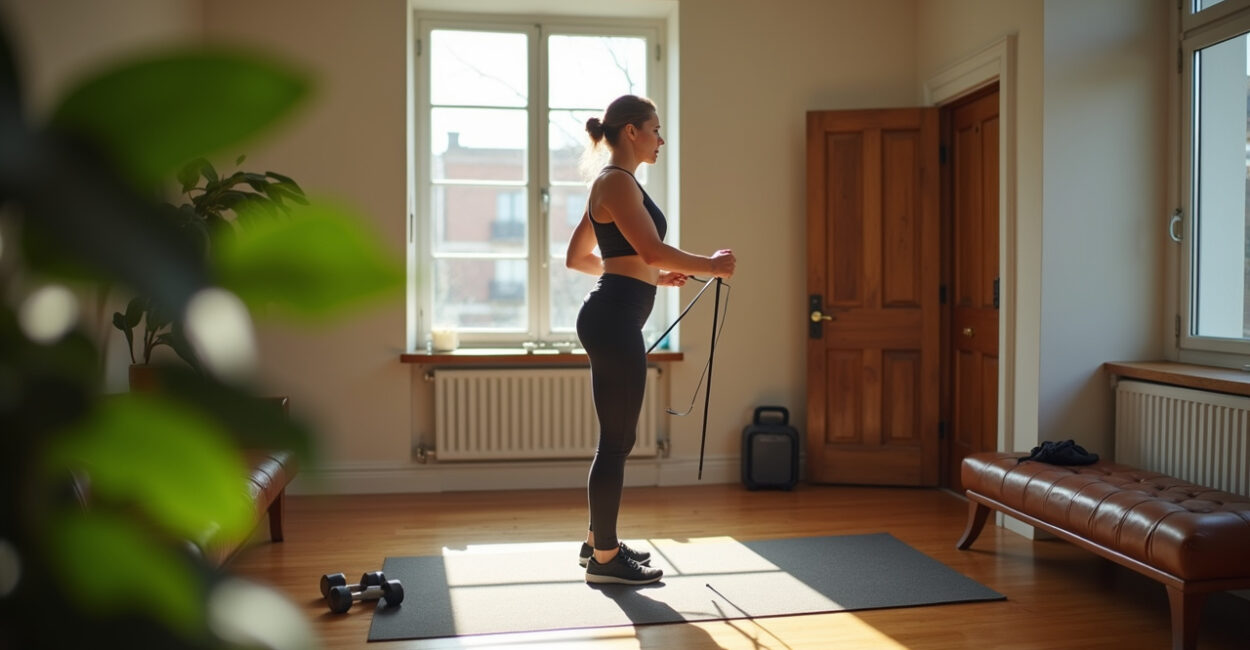
You’re mid-rep, breath heavy, and you realize the weight on your bar could be replaced by a thin loop of rubber. That feeling — of movement being equal parts clever and effective — is why resistance bands are quietly demolishing the “you need a gym” excuse. These bands deliver real muscle stress, fix side-to-side imbalances, and free up mobility work you never had time for.
Below: six gym-level moves, how to pick the right bands, safe anchors, and a simple plan to progress so you actually build strength at home.
Why Resistance Bands Can Outwork Dumbbells for Muscle Activation
Bands create constant tension in a way free weights don’t. When a band stretches, it increases load smoothly through the range. That means muscles fight throughout the whole rep, not just at the middle. For many exercises this boosts time under tension and forces stabilizers to help more.
Think of a biceps curl with a band versus a dumbbell. The dumbbell is hardest halfway. The band gets harder at the top. That change recruits fibers you rarely hit with plates. Use resistance bands to overload end ranges, fix sticking points, and train the smaller muscles that keep you pain-free.
Pick the Right Bands Fast: A Simple Selection System
Stop buying every color. You need three levels: light, medium, heavy. Light for mobility and shoulder work. Medium for bodybuilding-style sets. Heavy for lower-body and compound pulls. Choose bands by feel, not color.
- Light: 5–20 lbs tension — warm-ups, rotator cuff, glute activation.
- Medium: 20–50 lbs — rows, presses, curls for most people.
- Heavy: 50–100+ lbs — squats, deadlift-style pulls, progressive overload.
If you want numbers, many brands list approximate tension. Still, buy a set and test: if you can do 12 strict reps with room for 2–3 more, that band is your “working” band.

Anchor Like a Pro: Safety Tips and Creative Setups
Bad anchors ruin a session and can injure you. Always use a solid anchor point and never loop a band around an unstable object. Doors, racks, and heavy furniture each have rules.
- Door anchors: place at hinge side and check the latch. Use a towel on the hinge side to protect the band.
- Floor anchors: heavy kettlebell or closed heavy furniture works; clamp the band under weight, not a leg.
- Body anchors: loop band around your own limbs for beltless deadlifts or leg curls — keep tension even.
One trick: thread the band through a carabiner and clip to a strap. It gives consistent angles and faster swaps between moves.
Six Moves That Beat the Gym — How to Set Reps, Tempo, and Progress
These six moves together hit every major plane and force quality reps. Do them as a circuit or split across days. Use bands to add tension where you need it most.
- Band Squat (heavy band around hips or under feet): 4 sets x 6–8 reps, slow 2s down, explosive up. Progressive loading: add band or double up bands.
- Single-Leg Romanian Deadlift (band in hand, band under foot): 3–6 sets x 6–10 reps each side. Builds posterior chain and fixes imbalances.
- Chest Press from Floor or Anchor: 3–5 sets x 8–12 reps. Keep shoulder blades pinched to protect the joint.
- Band Row (anchor at chest level): 4 sets x 8–12 reps, pause at full contraction for 1s to teach scapular control.
- Overhead Press (standing, band under feet): 3–5 sets x 6–10 reps — perfect for core anti-extension work.
- Band Pallof Press (anti-rotation): 3 sets x 12–20 seconds hold — mobility and anti-rotation strength in one move.
Progress by increasing reps, adding a second band, or decreasing slack. Keep a simple log: if you can do two more reps than last week, up tension or band count next session.
The Mistakes That Make Bands Useless (and How to Fix Them)
People think bands are just “light resistance.” That’s the biggest mistake. If you treat bands like a toy, you’ll get toy results. Common errors:
- Using too light a band for compound moves — you need real tension to stimulate growth.
- Poor anchor placement — angle matters; wrong angle can turn a row into a shrug.
- Relying on momentum instead of control — bands punish sloppy form quickly.
- Not progressing — same band, same reps, forever. That’s maintenance, not growth.
Fix them by testing working sets, recording weights/tension, and focusing on slow eccentrics. Small tweaks yield big muscle gains.
A Surprising Comparison: Band Training Vs. Gym Machines
Expectation: machines isolate and always win for hypertrophy. Reality: bands often produce similar or better activation with fewer joints loaded. That’s because bands create a variable load curve that matches human strength curves.
Practical result: a band bench press plus a band row can tax your chest and back like a machine circuit, while also improving core and shoulder stability. For many people, two well-chosen bands plus creativity replace a half-hour machine circuit — and with less joint stress.
How to Build a Six-week Band Plan That Actually Increases Strength
Start with a baseline week: assess one-rep quality for each of the six moves (not a true 1RM — your best strict rep). Then follow three phases: volume, intensity, and mixed. Each phase lasts two weeks.
- Weeks 1–2 (Volume): 3x/week, higher reps (8–15), focus on form and time under tension.
- Weeks 3–4 (Intensity): 3–4x/week, lower reps (4–8) with heavier bands or double bands.
- Weeks 5–6 (Mixed): alternate weeks of volume and intensity; aim to beat a baseline rep count.
Track one metric: the top strict reps per exercise. If it increases, you’re getting stronger. If it stalls after two weeks, change band tension or swap a movement variant.
For extra reading on resistance training principles, see this review on resistance training and practical load advice at CDC physical activity guidelines.
What to Expect After Six Weeks — Real Results and a Quick Checklist
Most people see noticeable strength and mobility gains in six weeks if they train consistently. Expect:
- Better single-leg balance and fewer asymmetries.
- Improved overhead mobility and less shoulder pain.
- Visible muscle firmness if nutrition supports it.
Quick checklist before you train: check anchors, pick correct band for the movement, warm up dynamically, and aim for progressive overload. Little consistency beats occasional intensity. Treat resistance bands like tools, not toys.
How Long Until I Replace Gym Weights with Bands?
Many people can replace most gym sessions within 6–12 weeks if they follow a structured plan and progressively increase band tension. Bands cover pushing, pulling, and lower-body patterns effectively. You may still miss maximal barbell loads for absolute strength testing, but for muscle growth, mobility, and functional strength, bands are equivalent for the majority of trainees. The key is consistent progression, proper anchoring, and selecting bands that truly challenge you for the prescribed rep ranges.
Can Resistance Bands Help Fix a Strength Imbalance?
Yes. Bands are ideal for correcting side-to-side differences because you can work one limb independent of the other without needing two machines. Use single-leg or single-arm variations and track reps per side. Make the weaker side do an extra set or two, or start every session with it while you’re fresh. Add slow eccentrics and paused reps at the hardest range. Over weeks, neural adaptations plus targeted tension help the weaker side catch up while reducing compensatory patterns that cause pain.
Are Bands Safe for Older Adults or Those with Joint Pain?
Generally, yes. Resistance bands provide low-impact resistance and allow gradual loading, which is easier on joints than heavy free weights. They let you control range of motion and reduce shear forces. Start with lighter bands, prioritize tempo, and avoid sudden snaps in tension. Pair band work with mobility drills and consult a clinician if you have an unstable joint. Many rehabilitation protocols use bands because they strengthen supporting muscles without the compressive load of heavy weights.
How Do I Know When to Add Another Band or Increase Tension?
If you can perform the top reps of your set with good form and could do two or more extra reps, it’s time to increase tension. Options: switch to a heavier band, double bands, or shorten the band to reduce slack. Another rule: if you complete your prescribed reps for two sessions in a row without form breakdown, increase tension. Keep small, consistent jumps so you can maintain tempo and joint health while still forcing adaptation over weeks.
Can Resistance Bands Improve Mobility as Well as Strength?
Absolutely. Bands allow controlled eccentric work and end-range loading, which help improve joint range and tissue quality. Use bands for assisted stretches, controlled loaded end-range holds, and slow eccentricalisations to teach the body new length and strength at the ends of motion. Combine with breathing and soft-tissue work for best results. Over a few weeks you’ll notice easier overhead movements and less tightness in hips and hamstrings when bands are used properly alongside strength work.